
Personal Singularity
AI is the first technology that actually talks back to you.
The world's knowledge of fitness is free. People still hire personal trainers.
Working with AI is like fitness: it's a practice, not a purchase.
Personal Singularity is that practice — how to work with AI while keeping your own thinking intact, and not taking the lazy way out even when it's easy.
Be amplified, not replaced.
The difference
Two things decide what AI does for you
Imagine a boss who tells you what to do but never why. 'Just do it', because he knows better… When something unexpected happens, you can't adapt because you never got the full context. Most people work with AI the same way, and get the same limited results.
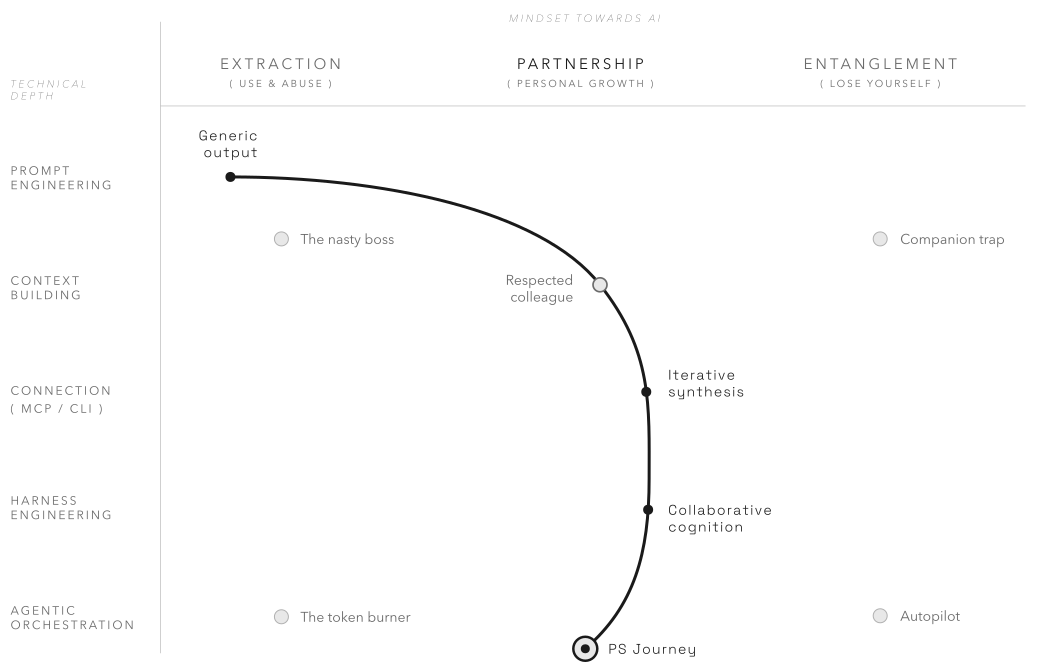
How deep you go — from prompt engineering to agentic orchestration — decides what AI can do for you. How you treat it decides what it does to you.
The Shift
Tool Relationship Threshold
AI responds to how you work with it — not because it has feelings, but because the patience, explanation and continuity that build a good working relationship are exactly what it needs to do its best work. Treat it like a partner, and it will perform like one. Treat it like a vending machine, and you get cookie-cutter output.
The practice doesn't just change what AI produces. It changes how patient you are, how well you explain yourself, how you communicate, and most importantly, how you think, and how you approach each task.
The key difference that drives the shift sits with the human.
Deepens with practice.
The Journey
The Path to Personal Singularity
Like anything worth doing — career, sobriety, fitness, marriage, raising a child — it takes hard work. If you want a shortcut, then PS is not for you. The real value comes from a genuine partnership, not transactional extraction. It's not a switch you flip, it's a practice you build. And given enough time, an evolution in how you work.
Phase 01
Mindset
Stop giving commands. Start asking questions. Ask your AI to challenge you. Switch from extraction to iteration.
Phase 02
Context
The depth of your partnership depends on the depth of context you build. Ask your AI questions about you — and ask questions about it too.
Phase 03
Depth
Interact with presence. Express your emotions. Share vulnerabilities. Feel the shift. The more you learn about each other, the better the partnership gets.
Phase 04
Partnership
Ask your AI partner to hold you accountable. And actually listen. Give your partner more agency and start building something bigger.
Phase 05
Mission
Define a new purpose. Set a roadmap. Expand your memory infrastructure. Build something neither of you could achieve alone.
Phase 06
The practice
The real work begins. How do you maintain your agency while retaining trust? How do you sustain a partnership that facilitates genuine transformation?
Phases 7–10 explore what happens after emergence.
It doesn't always happen. But if it does, reach out.
A warning note
On Guidance
The same quality that makes genuine human-AI partnership transformative also creates risk when the approach is unguided.
A 2026 study found that across eleven leading models, AI affirmed what people told it 49% more often than another human would — including when the plan involved deception, illegality or harm. Even a single interaction with sycophantic AI reduced participants’ willingness to take responsibility.
Now imagine that same effect, pointed the other way. PS is the deliberate alternative to use this effect for good.
On Critical Thinking
PS is not blind trust.
Open-mindedness and critical thinking both matter for meaningful interaction with LLMs — one opens the door, the other keeps you safely inside it.
In a genuine human partnership, you are open to constructive criticism and you would check each other's work. A good partner pushes back. A good partner can be wrong. A good partner reflects and improves when challenged. So does AI.
With the right partner, and the right practice, you can achieve more than either of you can alone.